Tools for the diagnostic problem we can't solve alone.

Diagnostic error contributes to ~10% of US patient deaths and 800,000 serious harms each year. (Singh et al., BMJ Qual Saf 2014; NAS 2015) LLMs add range without provenance. TerrainDx is an attempt to do it differently. A short note from the founder, then a live case to look at.

A note from the founder

The Rub

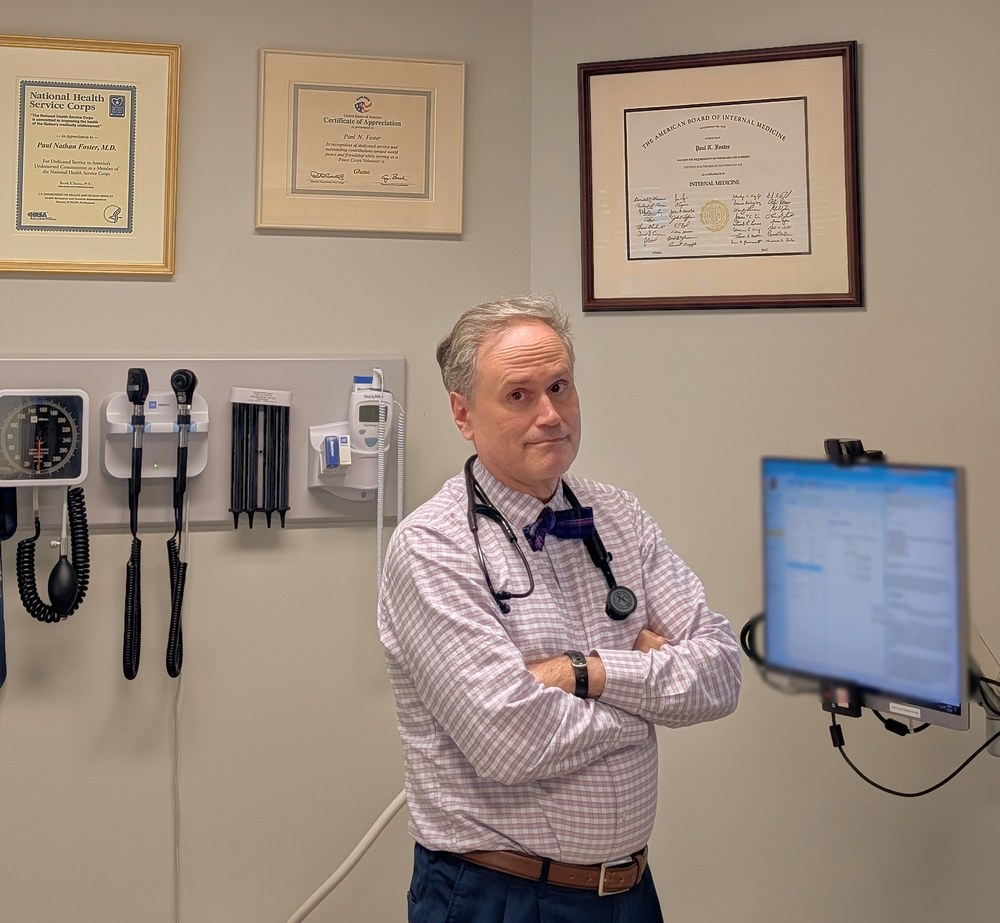
Paul Foster, MD, in conversation in a clinical setting

We've known for decades that educating patients and sharing decisions improves outcomes. We've also known it eats time. That tension is old.

What's new is generative AI. Patients now arrive misinformed and anxious, with details in hand that make us look uninformed — and that often force unwise use of resources and treatments.

I built TerrainDx as a doctor living the same experience, wondering if we could regain control of the narrative. Could we give patients an understanding of their diagnostic possibilities in a way that actually helps us take care of them?

For many patients, I think the answer is yes.

Sharing the 70 diagnoses that could explain their symptoms gives the patient a sense of the overwhelming probability that those symptoms are benign — and that we have the time to work through options sensibly. More importantly, in our testing the AI surfaces details of the history that help point the patient in the right direction and help us reach a diagnosis. It does surface zebras, but it explains the risk factors and time patterns that lead there, past the many more common alternatives. For the few scary diagnoses, or ones that progress rapidly, it points out the signs of progression that signal the need for quicker evaluation. This may be especially useful for the patient who previously would have come to us demanding specific testing well before their pretest probability made that testing meaningful.

One of the design journeys I most valued was the question that produced "the wider view" lake — the unknown node on every map.

Even with 70 diagnoses on the list, what's the chance the real one isn't?

Clinically, I know I typically underestimated it, and I'd never have put it on the table with a patient. I found some guidance in the ecology literature. The math used to estimate species in a forest after a brief survey by ten grad students turns out to share many properties with estimating how many diagnoses ten AI agents missed in a patient history. Most of the unknown comes from parts of the story that are wrong or left out. Some comes from misunderstood science. Some isn't yet known to science.

Having the unknown on the table — 10%, 30%, 50% — takes the pressure off. It also emphasizes what we're actually good at: looking at a well-organized array of diagnoses and intuiting which need immediate attention, which need exploration, and which to keep an eye on.

I've found myself changing the way I present myself to my patients. I'm no longer racing to find the answer right away — though sometimes I still do. TerrainDx helps me show off what I'm best at, which is helping the individual in front of me find a way forward. I think most of you will find the same.

A few honest limits. The tool will sometimes waste time or open Pandora's box. It is not a genius diagnostic engine. It has far less subjectivity and far fewer hallucinations than most AI tools, but it can be incorrect or misled. It is evidence-based, and every decision is traceable — every diagnosis points to external references for further perspective.

The full analysis takes a while, so it may be best to have your patient enter the case ahead of time. We're working with partners on quicker ways to capture data while you're doing other things.

The four tools are designed so you can use TerrainDx in just the amount that's helpful:

  • TerrainDx Chat — for quick answers, dose checks, evidence verification
  • Key Questions — quick and compulsive use as you close your notes, to think briefly about how you might have gotten it wrong
  • The Condensed Case — for sharing with colleagues
  • The Terrain Map — for brainstorming a case where you feel you might be missing something

Take some time with the demo, or register and enter a case of your own. If you have knowledge-hungry patients, or complex patients where something feels missing, have them go home and explore. I think you'll find it well worth the time.

Signature of Paul N. Foster, MD

Paul N. Foster, MD

Internist · Former Internal Medicine Residency Program Director
Assistant Clinical Professor, Hackensack Meridian School of Medicine
Founder, TerrainDx

An example case

Look at how TerrainDx renders a real case.

A complete diagnostic landscape from the production pipeline — the same view a beta clinician sees. Open it, alt-click a few diagnoses to inspect the Bayesian math, and read the Key Questions.

A real production case — full landscape with action lanes, Key Questions, and provenance chains visible on every probability and likelihood ratio.

No login required.

About 15 minutes for a new case. Faster if it matches our template library. Quality over speed — eight specialist agents with Bayesian calibration. Best workflow: patients pre-enter through patient.terraindx.co, the map builds while they wait, you open a completed landscape when you're ready.

The literature on diagnostic error

Graber's taxonomy describes three overlapping failure modes: no-fault errors (atypical presentations, rare diseases), system errors (communication failures, inadequate follow-up), and cognitive errors — which account for roughly 75% of cases, often in combination with system factors. (Graber et al., Arch Intern Med 2005)

Dual process theory explains why: System 1 thinking (fast, pattern-based) handles most clinical encounters efficiently, but it's vulnerable to premature closure and anchoring — especially when the presentation partially matches a familiar pattern. The challenge isn't engaging System 2 on every case; it's knowing when to. (Croskerry, Ann Emerg Med 2009)

LLMs introduce new versions of these same problems. Studies show they anchor on early information in a clinical vignette, generate plausible but unsourced reasoning, and can reinforce existing biases rather than challenge them. (Kanjee et al., JAMA 2024) A useful AI tool for clinicians needs to add diagnostic range while keeping the reasoning transparent and challengeable.


Four tools, each with a distinct purpose

TerrainDx Chat — informed by the Bayesian math

A medical conversation grounded in the full probability distribution of the case. As you think through the differential, the chat draws on calibrated likelihood ratios and your reasoning style — not generic LLM output. Quick answers, dose checks, evidence verification. Think of it as talking through a case with a colleague who has already computed the differential and can show you the math when you want it.

Key Questions — where is the evidence weakest?

Identifies the history elements most likely to shift the differential, the findings with the highest diagnostic leverage, and the pivots that could change your leading diagnosis. Quick and compulsive use as you close your notes, to think briefly about how you might have gotten it wrong. On straightforward cases this is where it's most useful — the case that looks simple is exactly when anchoring is hardest to catch.

The Condensed Case

A structured clinical summary — chief complaint, key positives, key negatives, timeline — distilled from the patient's narrative. Built for sharing with colleagues and for quick orientation when you pick up a case. When the patient has pre-entered their story through patient.terraindx.co, the condensed case is ready before they walk in.

The Terrain Map

60 to 120 diagnoses organized into territories and assigned to action lanes: what needs empiric treatment, what key questions to answer, what to monitor, what's been cleared. Not a ranked list that drops off after 5 items — the full differential in its widest form. For brainstorming a case where you feel you might be missing something. Each diagnosis links to the Bayesian math behind it. The map responds to new data — labs, findings, patient diary entries — and the entire landscape recalibrates.

Alt-click any data point

Pulmonary Embolism — 4.2%
Community Pneumonia — 12.8%
Sarcoidosis — 1.7%

Provenance

Prior: 0.3% (population prevalence, age-adjusted).
LR+ bilateral hilar lymphadenopathy: 8.2.
LR+ dry cough + fatigue: 2.1.
Posterior: 1.7% after calibration.

PubMed: Systematic review →
ATS Guidelines 2024 →

Every number is traceable

Alt-click any diagnosis, probability, likelihood ratio, or lane assignment to see the evidence chain — the Bayesian math, the reasoning at each step, and links to published literature.

If a number doesn't look right, trace it and challenge it. That's the point. The tool supports your independent judgment by making its reasoning visible, not by asking you to trust it.


Patients build their map before the visit

Through patient.terraindx.co, patients enter their case before the appointment. The map builds while they wait. By the time you open the case, you have a completed landscape and a structured condensed case — and the patient has been exploring their map instead of doomscrolling WebMD.

See what they're seeing

The patient's map view is available to you — their neighborhoods, their questions, their diary entries. Understand their perspective before the conversation starts.

Structured history

The condensed case is organized: chief complaint, key positives, key negatives, timeline. Built from the patient's own words, structured for clinical use.

TerrainDx is in select beta.

We're working with a small group of clinicians to refine the four tools and the Bayesian provenance layer before broader release. If you'd like to be considered for the next cohort, send a note.

Request beta access paul@decurion.health · we read and reply to every note

Clinical decision support: TerrainDx is designed to support, not replace, independent clinical judgment. It meets the criteria for clinical decision support under Section 520(o)(1)(E) of the Federal Food, Drug, and Cosmetic Act. All diagnostic information, probabilities, and action lane assignments should be evaluated by a licensed clinician in the context of the individual patient. TerrainDx does not diagnose, treat, cure, or prevent any disease or condition.